Monday, September 1, 2014

Life Here - An Overview

 For those I haven't been talking to over the phone, I figured I should give a short overview of what my life is really like here - where I am, who I live with, what my daily routine is.

To start, I'm living with a wonderful family made up of two older parents, their daughter-in-law, and her four year old daughter. They are completely hospitable and caring, and I enjoy having someone my age in the family and a young child to play with.
My House


My Room (Complete with a Bug Net, Thankfully)


My school is literally ten feet from my home. It is a fairly big school, with supposedly 900 students, though I've only ever counted around 500 students in the morning (maybe this is just grades 1-8). It is frustrating being at such a large school with such huge class sizes, but there are many benefits to the school as well. The teachers are kind and easy to work with - they are probably my favorite part of the school - and there are a variety of students and levels to work with. Each day, there are eight 40 minutes periods of class, in between which there is lots of sitting and sometimes drinking tea. I've been attending six of the eight periods and may do seven or eight in the coming weeks because there are so many classes I'd love to do.

After the school day is finished, I normally return home and sit outside the house with my family and others. My Ama brings me tea and a snack and I study Nepali while Sochina does her homework. Sometimes in the evenings we will go for walks - which I'll mention in another post - or I'll play "Ring Around the Rosy" and "London Bridges" with Sochina and her friends until I'm too tired to play any more. I've also started cooking with my Bauju, snapping long beans into bowls and mixing cooked spinach with spices.

Evening time comes with the electricity randomly coming off and on. After a big meal of dahl baht, tarkari (vegetables), and masu (meat), my Bauju and I often go upstairs to play cards or other games. We go to bed early (often around nine or ten o'clock) and if I'm lucky there will be a rain and thunder storm in the night to listen to. Life begins in the village around five o'clock, so I try to get up by six as well. Preparing teaching materials and plans can often take me two hours, but luckily the morning is long and relaxing.

As you can probably tell - I'm surrounded by many good things and have easily fallen into a comfortable routine here. My family, teachers, and students are already so important in my life - and I promise my Bauju everyday that when I return to the US I will not forget her, as she predicts. I know very well that that will not be the case.

Learning Curve Times Ten (My First Week)


         The first week in any new environment is hard to explain - it's exhilarating, eye-opening, and exhausting all at once. It's the feeling of taking in and learning a million new things simultaneously in order to stay afloat in a sea of the unfamiliar. My first week here, with my new Nepali family and at my Nepali government school, has been just that, but to a an even greater extent - a learning curve times ten.

           I've been surrounded by wonderful people, enveloped by shy smiles from passing students, comforted by sweet tea and dahl baht - but that doesn't stop things from being overwhelming. I'm still straining with little success to understand my Ama's Nepali, constantly gauging facial expression to judge whether my actions are acceptable, and am always prepared with a smile and a "Kusi laagyo" (I feel happy) or "dherai mitho cha" (It is very delicious) whether I mean it or not. But I would be quick to say that the exhaustion of the steep learning curve is but little to the complete joy and insight even just this first week has brought me.

Afternoons spent sitting with my little four year old sister, Sochina, playing tickling games and exchanging smiles, nights talking with my Bauju (sister-in-law) about the difference between our customs and about our pasts, learning to eat with my hands, and walking along rice fields and back roads with Sochina and Sumitra (Sochina's friend) holding my hands - all these, and many more, make the struggle of the first week worth while.


I'm learning all at once that things here are similar and yet completely completely different. Seeing the students in school confirms that, as does exchanges with my Bauju and fellow teachers. The way life flows, the expectations, the views, and the opportunities here are so drastically different than they were for me growing up in a small town in Port Townsend, Washington. In all of the places I've traveled, I've never felt that the world was so different.

The other day, we walked to the river and one of my favorite teachers, Dilliram, told me about how when he was younger he had come to school from across the river like many students do now. The long wire bridge that stretched from bank to bank was only built eight years ago. So when he was a student, he had started at one side of the river each morning, he told me, and with a basket on his head to keep his books dry, he had swam from one side to the other, departing from a point upstream and ending downstream a bit on the other side. I gapped as he told the story, unable to believe it. The river was fairly big and fast moving. It's hard to conjure up the image of Dilliram as a young student, drenched by river water each morning as he made his hour long trek to school, only to get what I'm sure wasn't too much of an education at the time.

In America, I told him, a bus comes by your house to pick you up.

How vastly different our lives have been. And how vastly different they continue to be. Every day that I see my students I try to really understand what their lives are like and what their lives will continue to be. Every day I am learning, and every day I become more grateful for the opportunities I've been presented with in my life, that I know 99% of the people living here will never have.

I'm so excited and nervous both to be spending the next 7 months here. There will be many difficulties, I know, but I suppose if Dilliram swam across a river each day to get to school, I can handle this relatively small flood of new culture. You just have to get a little wet to get to the other side.

Saturday, August 16, 2014

Harmonies in the Dark

          On our walks back from Fulbright each evening, I've started making a habit of stopping at local cafes with big tables to color. Yes, color. Funny enough this the largest piece of homework we've had over these past few weeks - coloring flashcards, cuts out fruit, and paper teddy bears dressed in patterned pajamas. The reason I often stop at a cafe is because I know the moment I get home, no coloring will get done. There are too many better distractions - well really just one distraction.

           Picture this.. the lights have gone out, again, thanks to load shedding. With head lamps perched on our foreheads, Emily, Caitlin, Alanna, and I are sitting huddled together, half on the floor and half on the sofa, guitars in laps and lyrics typed out on a computer screen. Our apartment is tucked in far enough to be blocked from the sounds of traffic. Instead of the blaring horns and rumbling engines that have become so normal, harmonies swirl around us in the dark as we strum and sing and strum and sing. It makes for the perfect evenings - which is why we often don't put down the guitars for hours. Emily is teaching me to pick individual strings and we're both training Caitlin to go easily between the chords of G and C. I already know that it's one of my favorite memories from Nepal, and something I miss terribly once we're all at our separate placement.

       But having a bit of music during this trip has been a completely unexpected joy. I hope to use the guitar in English classes and maybe in after school clubs with students. The best part is that Emily is only a 20 minute ride up the hill from me - so we can always get together to sing together on our day off.

     As we leave for our families, there are going to be some big hugs going around. I'm going to miss these five other girls that have become my family here - who I've sat with so many time, sipping coffee or mint lemonades, marveling over history and philosophy and life with, and bursting into long fits of laughter with. It does make you treasure relationships and the people you meet... and I'm thankful there will be even more special people entering my life on Monday. I can't even know now what they might mean to me in the end.

"What've I got? I've Got an Accent"

                Christine Stone, our English Education instructor sits us down on the green carpeted floor of the Fulbright office and instructs us on how to play her version of English language dominoes. "Now you've got to say "I've got a bawnawnaw"' She instructs, "There you are, that's alright."


"I've got a bawnawnaw" we practice... as laughter escapes our lips.


        I expected many things coming into this trip - to try many new types of food, to battle Kathmandu's thick pollution, to do laundry out of a soapy bucket on patio tiles...

One thing I didn't expect: To come out our month long training with traces of a British accent.

       Christine is determined to have us teaching our students "proper" English. This prospect seemed quite ridiculous at first, and a silly thing to concern ourselves with, but after seeing the student textbooks, it's become apparent that teaching the "American" way of saying things would in fact only cause more confusion for our students. Of course, a British accent isn't a requirement for teaching the phrase: "What've I got? I've got a rucksack and a rubbish bin."  But it kind of comes naturally anyways, especially when we are attempting to copy Christine charismatic manner of speaking.

This trip is going to be full of many things unexpected. It's only been a month, but I'm already starting to compile quite a long list of unexpected experiences. Here are a few more to be added, in addition to dealing with over-sized moths and sideways head-bobbles.


1. Falling absolutely head-over-heels in love with the stunning beauty of Kathmandu's "Monkey Temple"


2. Also falling in love with the thousands of adorable baby monkeys that live there


3. Getting locked in a bathroom (don't worry, I eventually got out)

4. Accidentally trying to order Kurtas in a blanket and pillow shop
 (It finally caught our attention that the fabrics were quite a bit bigger than in the other shops)

5. And getting completely soaked by a monsoon (despite having an umbrella)

More to come. All my love to those back home. 


Saturday, August 9, 2014

Mud Roads and See You Tomorrows

           "Eota hapta matra bawki" our teacher reminds us. "Tinjana Gorkha jaane ra tinjana Lalitpur jaane." Only one week left and three of us will go to Gorkha and three of us to Lalitpur. We won't be continuing in our routine of lessons and trainings and cooking together in the evenings. Instead we'll be stepping into completely different worlds with different families and a school of our own. "I've only just now figured out the way from our apartment to the Fulbright office and back," Caitlin sighed. It feels like a very short few weeks for me here too. Especially this past one as we made a trip to Lalitpur to visit the last three schools and did two days of teaching practice in a nearby government school for Tibetan refugees.
           To begin with, Lalitpur is a beautiful area. It is very close to the city (maybe only a 45 minute drive) and yet it feels very secluded and rural.
One of the schools is all the way up on top of the nearby mountain, a very big mountain. Nepali people, or at least the ones I've met, seem to have a tendency for predicting the period of time a walk or hike to be much shorter than it actually is. Everyone seemed to think the walk from our apartment to the Fulbright offices would be only 15 to 20 minutes - when in reality, even walking fast, it took us an hour the first day and 45 minutes once we had found the best route. For the mountain school, they told us we might have to walk to school each day from a home stay at the bottom of the hill; a half hour walk they said. After zigzagging back and forth up an extremely long and sketchy mud road to the school, it's obvious that this is a horrible calculation. The climb could easily take an hour and a half, though maybe it'd only take a half hour down the mountain if you decided to do somersaults off the side of it instead of walking. Either version would probably be safer than slipping and sliding through the mud like we did in our Fulbright Jeep (This may be a bit of an exaggeration, but I was terrified at the time). Lucky for Caitlin, who will be going to this school, there is another home stay option at the top of the hill.

            The other exciting part of this week, as I mentioned, was doing our teaching practice at a nearby school. Elsie and I made paper fruits and vegetables and a simplified version of "The Hungry Caterpillar" to read to our class. Though the class was a little big and wild at first, the students loved the games and songs, and of course, it was a great joy for us as well. In between periods older students came to ask us our name and begged us to come teach in their class as well. After a successful two days, Christine (our teacher trainer) took us out for coffee and we laughed about how the students had all asked to go to the bathroom at the same time and wouldn't reenter the classroom unless we had given them permission. I can still hear the sound of the students singing the song we had taught as we left the classroom, "Goodbye, goodbye, see you tomorrow; Goodbye, goodbye, have a nice day."
          Getting to teach was all the more exciting now that we have figured out which school each of us will be going to. Though we've only seen our schools and home stays just briefly, its nice to be able to envision and dream about where we will be living and teaching for the next seven months. My placement is in a larger Higher Secondary school at the bottom of the Gorkha valley. I will be just a short ride away from the Gorkha Bazaar and two other ETAs. I'm looking forward to exploring the rice fields, meeting all of my students, and playing with the three year old granddaughter at my home stay. Only three weeks in, it has already been an incredible journey. Below are a few pictures I have from my school.


Friday, August 8, 2014

A Country of Mountains and Villages

 Windy, downhill roads snake along the steep edge of the river, carrying colorful trucks and packed buses through the mountains away from Kathmandu. The scenery is a mix of the jungles of Thailand and the steep, bold mountains of Machu Picchu. Despite the drowsy effects of the anti-nausea medicine we had been advised to take, I fought to keep my eyes open to see every village, every green outline of the next mountain, and every long suspension bridge that stretched across the rolling river below. Stopping for a traditional Nepali tea break and then a lunch of Dahl Baht helped break up the four to five hour trip; soon we ourselves were crossing a bridge and crawling up and up towards the Gorkha Bazaar which sits on top of one of these green giants, looking into a valley of rice fields below.

           As you can imagine, it was a relief to be out of the city. The layers of mountains are a reminder of what Nepal really is: a country of mountains and villages. "It is beautiful, but life is very hard out here," Prava-ji, our Nepali language teacher, reminds us. Our drive takes us passed patches of women crouched in the rice field, others herding or carrying animals along the uphill road. Robin-ji also points out two of the selected schools on our way up and we stretch to catch a glimpse at the buildings.

        The Gorkha Inn where we stayed has a beautiful view of the valley, when it's not fogged in from the morning clouds. We are told the Himalayas are visible from here in early October, after the rainy season has passed. But in July they are layered behind a thick streak of clouds, painted across the sky just above the green tops of the surrounding so called "hills". Two or three times we were pleasantly surprised to see the peak of a snow capped mountain just barely visible through a gap in the clouds. The peaks are always higher up than I imagined they would be, stretching to a part of the sky I would imagine only for the sun or the moon. I'm sure a clear view of the Nepali skyline will be breathtaking.
            Our second day in Gorkha we filed back into our microbus to visit the three families and schools in Gorkha. Meeting the families and the students made the experience feel so real. Each school was so different, but as we met the students and teachers it was easy to see that we could all be happy at any of the places. It's the relationships with students and families that will eventually make each house a home. But it's wonderful to be able to get a glimpse of the families and schools before choosing where we will spend the next 8 months. For me, the decision will not be an easy one. I loved the first school for it's beautiful, remote location away from the Bazaar, the second for the loving, energy of it's teachers, and the third for it's high need and lack of resources. There are pictures below to give you a sense. I am in love with all of them, and grateful that our trip to see the Lalitpur schools and families is only one day away.

School Number One
School Number Two
School Number Three
               Our stay in Gorkha ended with a long hike up to a famous temple on top of the hill. The castle-like palace looked out to both sides of the mountain, framing perfect views for the hidden himalayas. Come fall, the place will offer a serene panoramic view. For now, the winding road brings through more villages and mountains, back to the bustle of Kathmandu.


Sunday, July 27, 2014

A Weekly Routine


Walking
View of the Mountains


          The first week always seems to stretch longer than the rest, maybe because it is full of so many new sights and tastes. Our Fulbright orientation here has proved to be quite thorough, even in just the first week. After a long, and often beautiful walk through Kathmandu streets to the Fulbright office each morning, we grab some tea and coffee to help us prepare for the day's activities: hours of Nepali language training, teacher training, introduction to the Nepali education system, current issues in Nepal, safety briefings at the Embassy, health briefings at the clinic, and discussions of history, culture, and gender issues. The past week has been a wealth of information and has greatly increased my ability to recite "Mero naam Lisa ho" (My name is Lisa) and other phrases with ease. Becoming as fluent as possible in Nepali is one of my dearest goals for this journey. The Nepali people seem to love it as well when we attempt our mangled version of "Ma ali ali Nepali sikchu" (I am learning a little Nepali).

        One of the best parts of our day is when the smells of delicious and authentic Nepali cooking seep in from the kitchen next to our conference room. As part of our grant, we are provided with delicious Nepali food everyday between sessions. Though we have found some good restaurants around where we live, nothing beats the food we get at the office: mixes of vegetables, seasoned okra and potato dishes, lentil soup over jasmine rice, and yogurt sauce to be blended with the spicy dishes. "Dherai Mitho Chaa" (It is very delicious) is understandably one of our most used Nepali phrases.
The Fulbright Office

Our Nepali Lunch

         The week has been full of other little joys: Meeting inspirational Teach for Nepal fellows, Kurta shopping at local, hole-in-the-wall shops, doing laundry on our porch in the coolness of the morning air, and watching kittens play in our garden below.

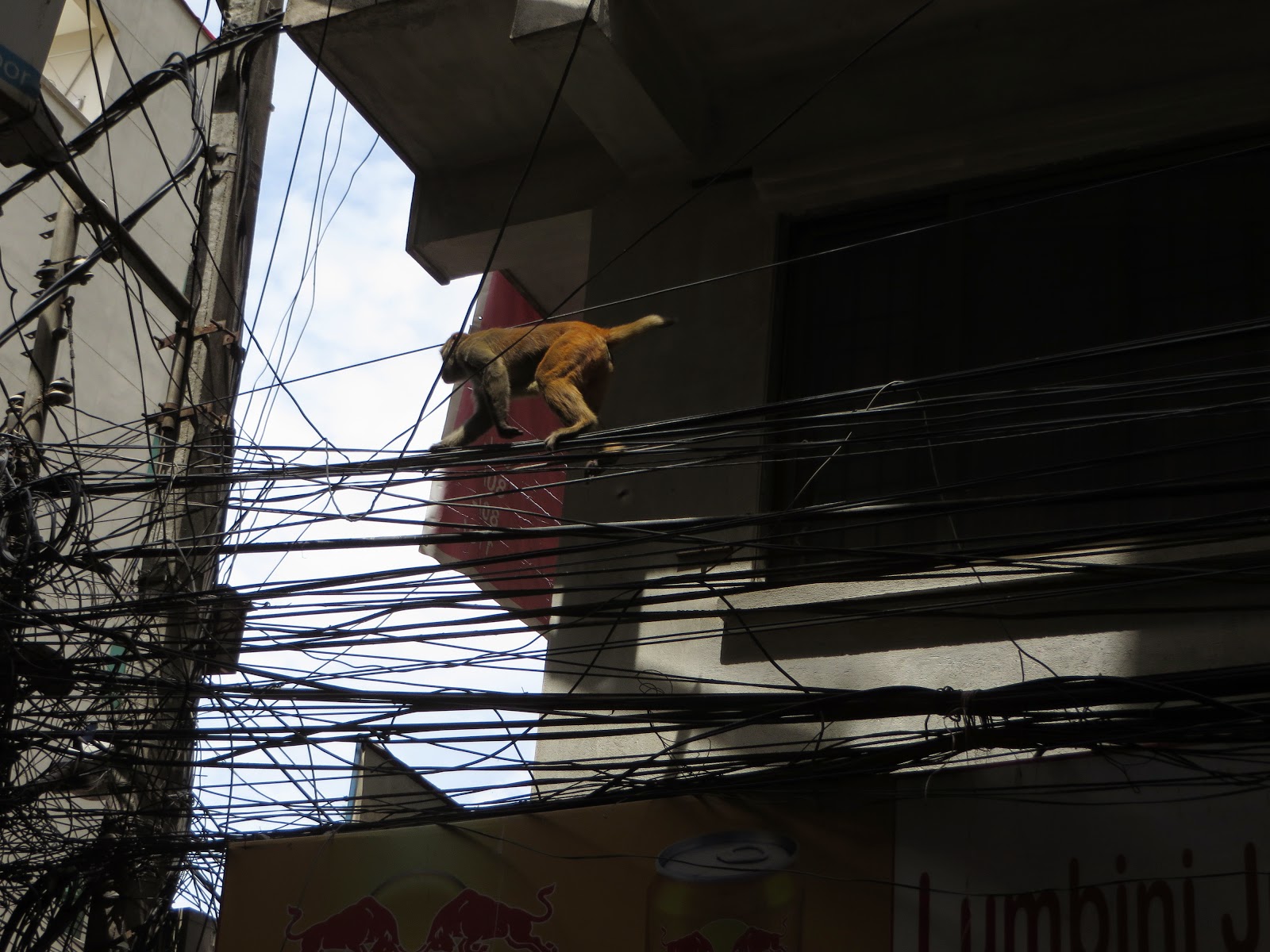
           We have become incredibly more comfortable stepping into traffic to cross the street, making the okay signal instead of the thumbs up signal (which is for a more inappropriate use here in Nepal), and forming our words into Nepali words and phrases. Even only a week later, Kathmandu is feeling more like home. Some things still catch me off guard of course: the monkeys that walk across the power lines, the power lines themselves, which are almost a bigger mess than the Nepal traffic scene. We also had a bird sized moth make its way into our apartment and terrorize Emily and I at night. Despite the fact that I knew not to be afraid of a moth, the loud flapping of its huge wings were enough to send me hiding under my covers in the dark. Luckily Alanna heard our screams and laughter and came to the rescue.
           Finally, the side to side head bobble that is a signal for "yes" in Nepali culture is something I'm not sure I will ever get used to. I still laugh when I see it. I know there are new habits you form when you cross cultural bounds, but I'm not sure turning a nod into a head bob is ever something I'll be able to do without laughing and thinking about it heavily beforehand. It's quite funny that something so simple can be so ingrained in our daily motion. For now, I'm sure I'll continue to instinctively nod "yes" despite the fact that a nod in Nepal can actually mean "no." Oh me oh my.

        The best of news is that we will be visiting Gorka, one of the villages in the countryside, next week. Three of us will be located there in three different schools. We are all very excited to be free of the city air, the honks, and the concrete blocks. This will all be left behind as we take the bumpy, dirt roads into the mountains. Until then, Namaste.