Monday, April 13, 2015

You've Got Mail

         Receiving mail from half way across the world is one of the best feelings possible. I already have quite a history of getting strange things in the mail - While in college my mom sent me a piñata (or two) and a rice crispy cake with the candles already on top of it. 

          Despite our history, I think this last care package takes the cake. I was giddy to receive a Christmas package from home - I'd requested York Mints and other Christmas candy to share. But while sitting on our apartment floor in Kathmandu, happily tearing open my package, I became shockingly aware that there was something giant and shiny in this particular box. 


        This realization resulted in a series of "Oh... My... God..."s and my-family-is-so-freaking-wonderfully-ridiculous laughter. 

     That's right. My family mailed me a waffle maker. You know you have the best mother, sister, and father in the world when they are crazy enough to mail you a freakin' kitchen appliance half way across the world. Not to mention, a kitchen appliance accompanied by your favorite pancake mix and syrup. Turns out, my sister didn't want lots of money spent on her for Christmas, so my mother gave her an empty box with a $100 dollars in it to send me a gift box. I'm not sure who in my family is crazier at this point... whose idea was this again?

     But this wonderful package item (that somehow made it through customs) resulted in me making absolutely delicious golden waffles all the way out in rural Nepal. Not the place I would have been expecting to eat my favorite food. But it was perfect. The perfect way to pull me back from my most difficult afternoons, to remind me that everything would be alright. The perfect way to give my Nepali family a taste of real American food that they actually liked, after weeks of botched pancakes. A perfect way to have a taste of home all the way in Nepal. 

       When I get home I owe my family a thousand thank you's, and maybe a few classes on how to not be so ridiculous. Though even a instructional series on how to be a normal family could probably never stop them from being so crazy generous and thoughtful. Guess I'm just the luckiest daughter and sister in the world. 


Thanks guys!

Friday, February 20, 2015

See the Mountains Everyday

"When you arise in the morning, think what a privilege it is to be alive;
to breath, to think, to enjoy, to love."

- Marcus Aureliuos

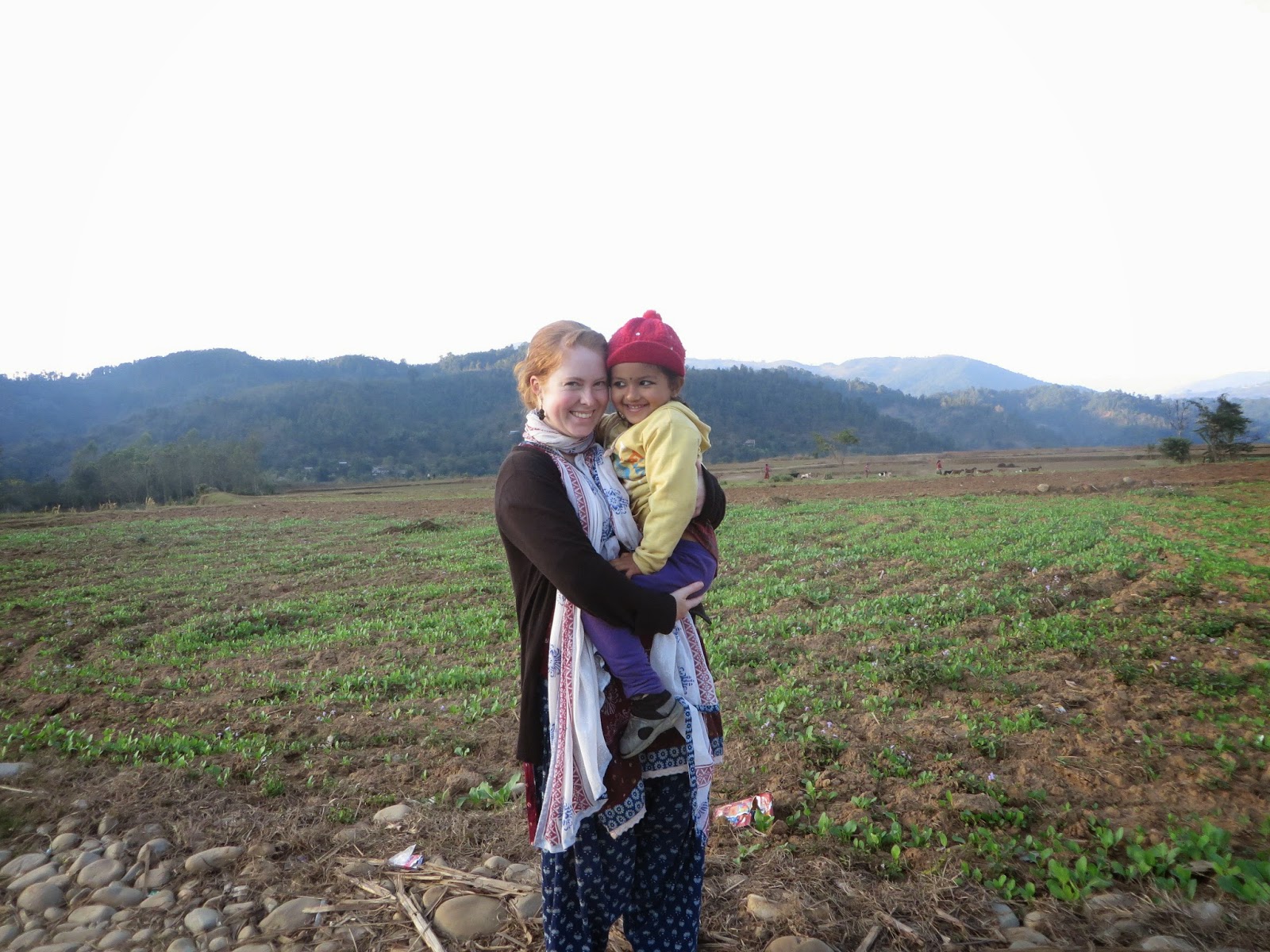
       One of the most enjoyable parts of my last few months here has been my commitment to truly enjoying Nepal's natural beauty each and everyday, whether via a quick visit to the rooftop at sunset, or an evening expedition with Sachina, Samitra, and Pabitra following close behind. My new mantra? - See the mountains everyday. This really only involves walking 50 feet away up from my house or down from the school. A very easy way to take a breath, and fill myself again with the joy of being alive. 
       Often times, these expeditions to see the mountains turn into longer walks, weaving along dirt and rocky paths with Sachina. Once we reach the fields, where several small trails dance in and out of rice patties and mustard flower fields, we simply just head towards the mountains.
         As we pass by the mud houses and farmers herding their livestock, kind-loving neighbors will always ask where we are headed. "Goomna," I'll tell them, meaning a "trip" in Nepali, sometimes with no particular destination. By now they'll smile and nod, having gotten used to my common response: "We are going to see the mountains."


On our evening walks

My lovely Bahini

(Note* never tell a five-year-old you are going to reach the top of the mountains' snowy peaks and return all in one day unless you really mean it. Jokes are not always taken well by five-year-olds.)


From my roof


The hills from the local bridge


From the Gorkha Temple


Sunsets from the roof 

Life in Gorkha

Proof that I'm in the most beautiful country ever. 

           I hope everyone at home is healthy and happy and that you also get the chance to metaphorically "see the mountains" every single day. 

Best wishes!

Thursday, February 19, 2015

Nepali Style


        As I have mentioned before, explicitly or implicitly in nearly all of my blog posts, Nepalis do things a bit differently. Very differently, actually - from our traditions in the United States. From how they treat illnesses, how they greet each other, how they eat their food, to how they show respect and hospitality, Nepalis have their own unique style of living. I've already commented on Nepali-style picnics and Nepali-style teaching, but I want to take the time to share a few other comment-worthy tasks that have taken their own shape in Nepali everyday life. 

Carrying Things:


First up: Carrying things. The Nepali-style of carrying things is definitely different from our method of transporting large items in the U.S. - though I'm not sure how many people really carry around large amounts of fodder in the U.S. anyways. The Nepali tradition is not to use backpacks or rolling carts - rather, Nepali's utilize a strap called a Naamlo that wraps across the upper part of the head. Using this strap - Nepalis can carry up to 50 kg of materials - bags of rice, a basket full of water bottles filled at the local tap, fodder for local goats, - I've even seen people in Kathmandu carrying large dressers and pieces of plywood via a Naamlo. To me it seems a most uncomfortable way to carry things (Ouch! Neck cramp!). But here in Nepal, most people will refuse to use any other method. 


My Ama transporting rice and enough fodder to be considered a tree herself. 


Making Bread:

         As you might expect, we eat a lot of rice in Nepal. A lot of rice. Everyday, three times a day, if I'm not careful. So when I heard we were making bread for the holiday, naturally I got pretty excited. Actually, we've had this version of fried bread - known as Sel Roti - few times before during other holidays and special religious ceremonies. It's always been a nice treat. For this recent one-day holiday, I was delighted to be apart of not only the eating of this delicious Nepali food, but of the production as well. On a warm quiet afternoon I headed over to one of my co-teacher's houses and was lucky enough to see the entire process. 

       You can imagine my surprise when I found out that this Nepali "bread," is actually made with rice flour. The one food that I thought was taking a slight veer towards my dearly missed American kana, was actually just another way to introduce more rice into my diet. Thanks, Nepal. 


           However, the process of making Sel Roti is still just as cool - even if it is made from rice. First, my teacher and her family used the foot-powered machine pictured above to pound the soaked rice grain into flour. Or, if you are like my Ama, you use a heavy metal pole that fits into a long metal cylinder. And then you pound the pole up and down for several hours - not even joking. She was definitely at it for at least two. My arms were sore after just two minutes. Nepali women definitely deserve more credit. My Ama is way stronger than me. 


Then, the flour is sifted and mixed by hand with homemade ghee (similar to butter), sugar, and water. 
The fire is prepared and oil is heated to cook the roti


            My teacher makes it look easy, but the process of squeezing the correct amount of mix into a perfect circle before your hand gets burnt by the hot oil is actually quite a skill. I didn't attempt it, but she did tell me that it required lots of practice. 


          And after less than a minute in the oil, the final product, a golden brown circle of slightly sweet fried bread is pulled out and stacked on a plate to be eaten with tea. My teacher stayed crouched near the fire for more than 2 hours, creating this joyful treat for her and her family. Despite the incredible time-consuming and demanding process, Nepalis seem to always look forward to making and eating Sel Roti. It is a reminder for me of how much Nepalis always find the joys in life - making it a priority to see relatives, enjoy good food, and dance. 


Cutting Down a Tree:
     This is easily the scariest out of the three Nepali-style experiences in this post. Sadly, the school cut down the giant mango tree near our house (cutting down any mango tree should be a sin) so that the money could be used to create a gate for the school (another not so efficient use of funds - right up there with paying $150 for a goddess-of-education statue when the first grade and kindergarden classrooms are in great need of some TLC). 
        To be honest, I'm not exactly sure of the methods and techniques used to cut down trees in the US, but I'd bet a large sum of money that they are safer than those used in Nepal.  

case in point

Nepali method number one: Send four or five guys up the tree without any ropes to climb out on giant branches and start hacking away. Thank god this man did not fall. I was definitely terrified for his life. 


Nepali method number two: After hacking off all the branches (and luckily taking down no more than one powerline with them), start sawing at the tree's trunk. When the tree is finally ready to come down evacuate all students, people, and babies from the nearby buildings (well that was our own decision, but it seemed to be the only reasonable choice). 

Nepali method number three: Tie a rope to the top of the tree and have a group of strong men pull on it to help the tree fall. Not enough people? Recruit the male class 10 students to do the job. You don't run the danger of parents suing the school if their sons get hit by a tree in Nepal - even if it was the school principle who told them to go help. 

       Luckily, the tree came down without any injuries (except to the tree itself), though I wouldn't be surprised if there are a significantly higher number of hospital admits claiming to have fallen out of a tree in Nepal in comparison to the US. But then again, maybe not. Nepalis are extremely capable people. Even so - I think once I return to the US, I'll be thrilled to pursue some of my old American-style habits: wearing a seat belt, eating a balenced diet, and commonly using and receiving the phrases "please" and "thank you."
     
But for now, it's back to Gorkha for some Nepali-style Dhal Bhat, chia, family love, and hospitality. I can't say no to that. 


Monday, February 2, 2015

7 Steps to a Wonderful Christmas Abroad

       * Yes, I am aware it is already February.
       * No, that doesn't mean it's too late to blog about Christmas. 

    Ahhem. I have found that spending your first Christmas abroad away from family requires you to do it right (if you are to avoid an excess amount of homesickness and I-should-be-eating-homemade-fudge-right-now type thoughts). And doing Christmas right abroad requires a few essential materials: Good friends, access to pizza, french toast, and coffee, a beautiful city to explore, and a paper Christmas tree. Here's some easy to follow (maybe) steps to help you have as wonderful of an abroad Christmas experience as I did this past December. 

Step 1: Make a Paper Christmas Tree.


           This is the first AND most important step. Because what is Christmas without a highly decorated Christmas tree? No suitcase-sized evergreens around? No problem. Green construction paper and some tape will do the trick. 

Note: Take this paper Christmas tree with you everywhere. Though we got some laughs, I'm pretty sure everyone actually just really enjoyed this extra bit of Christmas spirit, even if it was taped to what may have been a palm tree. 

Step 2: Get Your Mom to Send You a Ridiculous Amount of Gifts From America in the Mail. 


    Okay, it wasn't quite that many packages - but I honestly barely made it back to Gorkha on the local bus with the two giant packages she sent!

Thanks, Mom! :)

Step 3: Wrap Said Gifts in Newspaper to Give to Your Wonderful Host Family (and Make Paper Stockings to Boot!)

 .... because Christmas is more beautiful when you share it. Especially with a family who has never been told they have to wait to open their presents before. Surprises are especially fun in a culture that doesn't celebrate with them in the same way we do in the US. It was a little difficult to keep Sachina from opening all of the packages at once, but well worth it in the end.

     We made hot chocolate with our fresh local buffalo milk, turned on some holiday music, and watched the happiness of a first Christmas unfold.


Step 4: Get Yourself to a Lake and Eat Some Dang-Good American Food


           For this step, good friends highly enhance the experience. Also advised is a 10-minute version of Secret Santa where you buy each other a mixture of cheap gifts from tourist shops mostly consisting of over-sized wool hats and socks. 


"Friends in life are those that make you laugh a little louder, smile a little brighter, and live a little better."

Step 5: Go on an Awesome Excursion.


         I don't completely recommend getting lost in the woods and following a local gathering wood up a non-existent path for 40 minutes and then separating from her to trek off in the direction she claimed the trail to be. However, hiking and going on an amazing excursion I do recommend. We did find the trail, eventually. And... despite getting stabbed by the thistles of a thankfully non-poisonous caterpillar, we had a very relaxing hike to the beautiful World Peace Pagoda overlooking all of Pokhara. The best part of adventuring on Christmas is that you don't feel like your missing out on too much back home (heck yes I want to see an amazingly stunning view from a mountain in Nepal instead of being at home for Christmas - Sorry, Family! I love you!)


Also, you know you are doing Christmas right when you are pleasantly surprised
by wild Poinsettias blossoming everywhere!

Step 6: See the Sunrise (on the Himalayas if at all possible)


        This is quite possibly one of the most incredible experiences I've had while being in Nepal. First of all, the Himalayas are breathtaking by themselves. But when the rose-colored light of the sun is just painting their white tips in the first breaths of the morning - this creates a moment in time completely indescribable. The stunning view, seemingly just an arm-reach away from where our feet were placed beneath us, reminded me to never settle for anything less in this world. Anything less than beautiful, astonishingly amazing, breath-taking life. To never settle for anything less than being fully alive in every way possible. 


Extra bonus: Have a cup of milk tea while watching the sunrise on the Himalayas.
Does life get any better than this?

Step 7: Call Your Family and Appreciate All You Have.

     And of course, if it's Christmas, and you are away in a foreign country without your family, the most important thing to do (alongside making a paper Christmas tree) is to call your family and tell them how much you love them. Because even the best American food, even seeing sunrises, having crazy adventures, and being surrounded by good friends doesn't fully make up for how much you miss them. And it's important to let them know - whether it's for the millionth time or not - that you love them dearly, that they are your support system, your sunshine, and who you'll always be thinking about every single Christmas and every single day you are away. 

       When spending Christmas abroad, love all that is around you and all that is far away. Appreciate all you have, and celebrate the life around you. It is a very special thing. So enjoy it. And if that means ordering dessert at every single restaurant you go to, then do. 


Wishing you all love, laughter, and amazing adventures in the new year. 

Friday, January 2, 2015

An Education (and Why I'm Locking Myself in with the Kindergartners for the Next Three Months)

At this point I'm just shaking my head.

At everything. At some of the strange recommendations or demands that come from my family, at the unfathomable amount of times my teachers will blame anything and everything on the cold. At the way kids continue to thrust their papers into my face in an attempt to be tended to first - and the fact that sometimes it works.

More often than not, the strangeness, craziness, loudly colorful mess of Nepal, fades into the background for me as more normal than not. But some days, it comes running at me, slapping me in the face like a huge gust of 90 mph wind. Why can't the kids just be quiet for once? Did my teacher really just brag about hitting students more than any other teacher in the school? Is it really necessary to spell every single word out-loud in a frighteningly hypnosis-like chant?

        Nepal makes me really rethink the meaning of education. We insist, beg, and bribe kids to come to school; We rant about its importance. And I do believe education is important, more than anything. But I wonder sometimes if I can fully believe in the product we are selling at my school here in Gorkha, if I can still insist students stay in school; still insist that this is an education worth fighting for. Because sometimes I look at what the kids are learning, what they are truly being taught - and it's much more (or less?) than the ABC's and 123's.

          Firstly, they are being taught to memorize. To pour over meaningless words, to chant their spelling, to repeatedly, repeatedly, repeatedly drill lines and formulas. Nepali education squeezes every ounce of creativity out of children that it can, twisting and turning them until the last drop is gone. Students are taught to copy exactly what they see before them, to ingrain it in their brains - as though the brain was a blank copy, to be filled with the words lining the book of general knowledge. They learn this from the moment they walk into school - and as a result, I find my students are most calm when they are writing, copying dust-written letters from the chalkboard. It's what they know. And after they have copied the meaningless letters into their notebook, they won't feel validation unless a red Teek (check mark) has been written across their page. Whether it is really teaching the students or not - this is the role that has been taken on by many teachers in Nepal - come to school, write with chalk across the board, and give a red check of validation to those who can copy your words onto paper. As if that were teaching. As if that could ever constitute teaching.

          What else are the students taught? They are taught to cheat, to rely on others, and to shuffle into their assigned place in the Nepali classroom - the role of top student, or that of the others. The best students know who they are. They are the ones who are called on in class, whom the teachers address, whose scores the teachers love to look at and compare. I do too. It's fun to see the students who get nearly 100% on their exams, who come within one point of each other. It's easy to give these students attention. But so few people ever look at the other scores. Those who just barely passed the exam, more from guessing than from anything else. Or the students in class three that still don't know how to write their name, the first grader that wrote gibberish instead of "c-a-t, cat" despite how many times we've gone over it. What about the five students in grade one math that can't produce the number 3 or 4 when I ask them to write it? Who struggle to count to five? These kids learn to rely on the smart kids, if they want to get by. Cheating, prodding the teacher into giving them the answer, or simply having another kid write the answer for them.  As in most American classrooms as well, students are quick to learn their place - am I a good student or a bad student? I think I would be afraid to hear their answers. And when I feel at my breaking point in the realm of discipline, all I need is a quick remind that these kids need love and encouragement more than anything.

       Finally, they are learning to hit. I can't say enough about this one. You know that old phrase: "monkey say monkey do?" And its accompanying philosophical warning: "practice what you preach?" Well they are right on point... especially in terms of young kids that absorb things like sponges. I'm at quite a loss, because I spend half of my day telling kids not to hit each other, and the other half watching teachers, themselves, beat students. And how quickly the students have learned the Nepali way to deal with their problems (so much for Kelso's choices). These kids will hit each other for anything and everything. They push in line (if you could call it a line), they grab things from each other, they throw things. They even hit me (out of love I tell myself), hang off of me, shove things in my face (as I've mentioned before), and I've definitely had some things thrown at me - I probably should have run for the woods as long time ago.

       But no, I'm not in any real danger. My first graders sure are though. I literally have a kid crying in every single class. Or a bloody nose, a scrapped shin, a pen-punctured hole in someones hand. For the most part, the hitting isn't completely dangerous to the kids, in the sense that they don't usually hit hard enough to do any damage, but it is endless. And though I say the words "na pita!" (don't hit) like a broken record throughout the class, I know that it's exactly that - a broken record - and nothing more.  As long as the kids see the teachers come in with sticks, giving misbehaving students hard slaps across the back, they will never agree to practice the badly pronounced Nepali commands that come from my American mouth.

Because they have already learned a lot, through this education of theirs.


        On the other hand, I recently discovered this heavenly little sanctuary called Kindergarten. It's quiet, and happy, and filled with new brains with adorable little hats that look like football helmets. It's full of sponges that haven't been too heavily affected by all the things that have caused so many problems in all of my other classes. It's a warehouse full of boats ready to be built, instead a lake of sinking ships - with me desperately bailing water from boats with holes in their bottom.

         My father often laughs on days when I tell him I'm going to Kindergarten instead of class five. "You enjoy Kindergarten, huh?" he'll chuckle - likely with the common Nepali view that "babies" are too small to be taught anything.  But if Nepal has taught me anything - it's to know where a problem begins, and to not fight a fight you can't win. So when my class three teacher insisted we stick to the textbook for the next three weeks to prepare for the exams, I nodded my head, and headed for a different class. When my teacher told his students to copy three pages of their textbook ten times as homework, I took a deep breath and started planning for the lesson where I'm going to teach them present tense (because they should know what "I am happy" means by fifth grade). When my teacher comes in and draws four pictures on the board and asks if it's okay if she leaves for the hour, or stays in class only to stare out the window for the entire period, I let out a high-pitched scream of frustration inside of my head, and turn again to my students, to give them what she will not, and to the teachers who come in with a desire for change. I don't stay in sinking ships. I've learned to find the ones that I can patch.

        A good amount of time, I feel like I'm banging my head against a wall, but I'm also learning how to turn away from tall, immovable concrete walls to face a new direction. To know what I can change. And what I cannot. To see the progress in the teachers who adopt my songs and play new games in the class. To love the moments where I realize children I thought weren't listening have finally learned how to say "This is a hen." To love what is here, to learn from it, and to better it in ways that I am able. What is taught inside the walls of my school may not always be the greatest education for its students, but it sure has been an education for me.

Thursday, January 1, 2015

Baby, It's Cold Outside

         Surprisingly, most everything you could ever need is available in Nepal, if you look hard enough for it. The other ETAs and I have gone on some interesting adventures, coming back with many interesting purchases - kidney beans to use as markers for Bingo, clothing pins to hang up student work, overpriced packets of Uno and Jenga... we even found Reeses and Hershey's Kisses in Pokhara.

      The few things I can't find - mostly specific sweets that I find myself craving (smarties, york mints, hot chocolate) - I've received in packages from a certain wonderful mother of mine. But I've been pleasantly surprised at what is available in this country that is so different from my own. After some very thorough searches, I've had success in finding things like whiteboards, specific American breakfast items, good dark chocolate, and even baking powder.

My Oh-So-Wonderful American Breakfast Food in Nepal
              But, I think I may have finally reached my limits. My luck has finally been stretched to its breaking point... because I'm pretty sure what I need now is something nowhere to be found in Nepal, even if I searched it from top to bottom. You see, because what I have found myself needing this past week or so is somewhat of a strange item. Strange indeed. You see, I have found myself in great need of a....... snorkel.
Let me explain.

When the earth gets half way around the sun and is suddenly tilting away from its rays on my side of the equator, the days get quite short... which means a lot of dark, chilly fog and a very limited amount of gham (sunshine) to burn it off. This makes it cold, and also very difficult to dry laundry, shower, or eat oranges - because for some reason, in Nepal, it's only socially acceptable to eat oranges in the sun.

This doesn't explain why I might need a snorkel? Well, let me rephrase. With all the fog and the sun taking a long vacation from Gorkha, the Nepali "chiso" of winter has finally arrived.
 Just in time for Christmas: "baby, it's cold outside."

.... And inside. And in the tiled bathroom, and in the school classrooms, and in the office. It's cold, in the morning, at night. When I open my door, when I shut my door.  It's cold upstairs and downstairs. On the carpet and on the concrete. It's cold here, it's cold there, It's cold everywhere!

       Which leads me to my next point. There are no heaters in rural Nepal. or hot water to shower with. Or hair dryers. Am I making you cold just thinking about it? I'm currently wearing four layers on top, two layers of pants, a fleece hat, and wool socks while writing this.

          As soon as the temperature was a little less than 70 degrees outside, the Nepali's started complaining about the cold. But now it's in the 30's and 40's at night - so 3 months later, the Nepalis are finally right. The "chiso" has arrived.

Still confused as to why I need a snorkel? Understandable.

        You see, the only place I've found to be suitable for survival of these next few months, (despite the fact that I'm still expected to attend school and act like a regular human being) is the heavenly spot where, curled up, I am completely buried underneath two layers of heavy blankets in my bed. This, though cozy, is completely debilitating, in terms of getting anything done.

The result? I sleep a lot. Like a lot a lot. My thought train goes from "oh... I'll do some lesson planning tonight".... to "oh... it's a little cold in here, maybe I should grab a jacket"... to "actually, you know, those blanket wrapped around me would be a lot warmer".... to "hmm... It's kind of hard to write, and I'm letting the cold air in, better make sure I'm all wrapped up".... and then, somehow, I find that I've disappeared under my blankets into a horizontal position. And it's only 8 pm. "It's okay to go to bed at 8 pm right?".... "well, there's no getting out of these blankets now.. so I guess it's fine... I'll just get up early."

Well, you can guess what that looks like in the morning. Trying to pull me out of warm blankets, no matter how many consecutive hours I've already been in them, is like trying to hide chocolate from my bahini, Sachina - flat out near impossible.

But the good news is, Nepal has made me an inventor. Because the end goal is that I could be both productive and warm at the same time - which is what they invented snuggies for. Someone send me a snuggy suitable for Nepali winters (aka five snuggies that I can wear at one time). I've decided that my only practical solution, besides asking my mom to send me a space heater in the mail (also not so practical) is to lay the blankets over me like a tent and simply invest in a snorkel to take care of my face's inconvenient need for oxygen. Then I could type on my computer without loosing fingers in the process (to frostbite, of course), I could grade my student's homework, even read a book! Who knew the one thing I would need to complete my life here in Nepal would be something not readily available in landlocked, chilly country where every swim-able body of water is likely polluted anyways. They really should have put it on the packing list anyways.

            Since I probably won't be locating a snorkel anytime soon, here's to doing as the Nepalis do: wearing several layers of clothing at all times (to the point where I'm almost unrecognizable), only mustering up the courage to shower every seven days (opps, did I say that out loud?), and getting lots and lots of sleep.

And then, we do as the Americans do... run to any hotel with hot water as fast and as often as we can!

To all those back home, may you stay warm and healthy during this holiday season - but mostly warm.

Happy Holidays!


Saturday, November 29, 2014

This is Nepal

       It was the second bus I had run to that day. My Ama and I were returning from Abua, where our Aunt gives us fresh milk every morning from her Buffalo. Despite how much I enjoy sitting outside the houses of our relatives, looking over the fields below while sipping tea, I was trying to hurry us home so my Bauju wouldn't be stuck doing all of the cooking alone. As I caught up to the bus and grab one hand around the nearby railing, enough to hold onto in case the bus takes off mid-entrance (a fairly common occurrence in Nepal), my Ama came trotting behind with the milk and we clamber on.

       Well, more like we squeezed on, into a tightly knitted mass array of bodies wedged between worn seats. Though Nepalis are very hospitable when you are a guest in their house, they tend to be much less accommodating on crowded buses. There can be enough standing space for five people in the back of the bus (a lot for Nepal), and yet people in the middle will refuse to move back any further than forced. Aka, the front of the bus will look like the crowded pit of at a concert, while the back is spacious and open. I finally managed to wedge myself far enough into the bus that I wasn't concerned about toppling out the open door on any sharp turns. This, however, involved awkwardly leaning at a 45 degree angle over the seats of two nearby passengers, nearly falling in the lap of an older Nepali man, and straddling a goat (yes a goat) on the bus floor.

      Nothing shocks me too much on a bus anymore. But the most amusing thing about this bus ride, was that the lady with the goat seemed very convinced that I was going to step on her goat. My feet were carefully placed far from the goat, and I was more in danger of falling on nearby passengers than on her badly placed goat. Despite this, the small, fabric-wrapped lady continued to give me a strong push against my arm every thirty seconds or so. She obviously was not very happy. And I was near laughing at the strangeness of the situation, as I was falling into the lap of this poor old man.


The man looked up at me with a wrinkled grin and chuckled, cheer in his eyes. And the first words he said to me, with an amused laugh, as I grabbed at something to support my awkwardly angled position, was "Yo Nepal Ho!" - This is Nepal.

We had an enjoyable conversation for the rest of the bus ride, as the woman behind me continued to give me a few pushes every now and then in defense of her goat. Mud huts and bushy trees passed us by, as our bus rocked back and forth up the road home. His hilariously translated statement has stayed with me, in every moment when I'm again reminded that I'm not in the cozy town of Port Townsend, the busy lifestyle of Thousand Oaks where there's always a Starbucks not to far out of the way - but rather in Nepal. In the middle of green, loving, loud, chaotic, beautiful, breath-taking Nepal.


          I'm reminded when my Ama calls me in to see spiders the size of my face that have made their way in to our house. I'm reminded when my father tells me that if I don't sleep with a blanket over my face my head I'll have a sore throat in the morning. I'm reminded every time I go into school and hear students chanting pages of their textbook from their wooden benches. This is Nepal, ladies and gentleman. This is Nepal.


            Where students will thrust their notebooks into the small space between your face and the other student's book that you are currently checking. Where you might have to pry their affectionate arms from around your waist just to walk into the classroom. Where teachers will reprimand a child for hitting another kid and, as their punishment, proceed to hit them (more on that to come). This is Nepal - where black eyes, and scrapes and sores are normal, and school uniforms torn to the brink of literally falling off still cling to young students' bodies.


      This is Nepal, where people telling you that you're getting fat is supposed to be taken as a compliment, and where anything medical related is rarely tmi or kept private. Where MASSIVE amounts of rice are consumed everyday, and where despite eating the same food everyday, people will always say their favorite food is Dahl Baht.


          This is Nepal, where students call "Miss, Miss, Miss!" - a chant that will be ringing in my ears for years to come. Where neighbors sit in front of their houses, and always ask where you are going when you pass by. Where strangers ask you if you are married and then almost always follow up with the question: "which is more enjoyable - Nepal or America?"

This is Nepal. Where fog brings in the cold, and the school bells ring to bring my teachers wrapped in colorful scarves and hats. Where I spend nights sitting on my green carpeted floor stapling together yet another activity book for my students, craning over lesson ideas and new games. Where I can leave my school work behind to crawl into bed with my Bauju and lean over her tiny new born baby. His eyes will open just wide enough to make out my shape.


This is not cozy Port Townsend or bustling Thousand Oaks.
This is Nepal. Green, loving, loud, chaotic, beautiful, breath-taking Nepal.